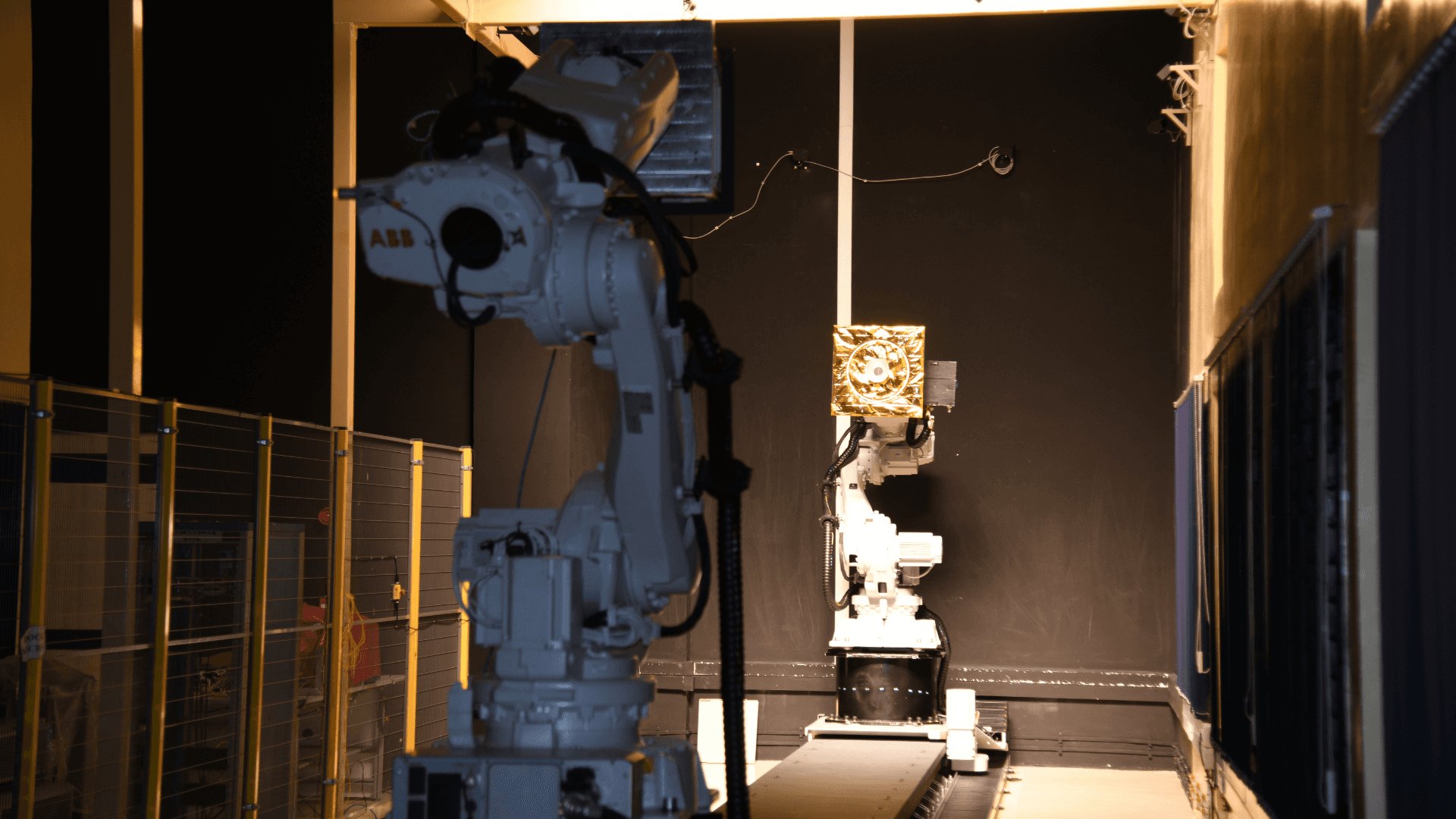


Aule Space has completed a closed-loop test campaign of its rendezvous, proximity operations, and docking (RPOD) navigation stack at the Rendezvous Simulation Laboratory (RSL), a facility operated by ISRO at its Satellite Integration & Test Establishment (ISITE). The campaign validated Aule's vision-based guidance, navigation and control (GNC) software, marking Technology Readiness Level 6 (TRL 6) for its relative-GNC stack.RSL is the most representative ground testing available for validating these capabilities before flight.
About Aule's Tech
RPOD requires a chaser satellite to determine the target’s position and orientation with precision, and adjust its own trajectory in real time to close in on it. This is harder with existing satellites in space that were never designed to be serviced. Most RPOD systems rely on LiDAR or other active sensors to do this. Aule has built its navigation system around cameras instead.
LiDAR is bulky, power-hungry, and expensive, which increases the overall satellite's size, weight, and power (SWaP) requirements and ultimately total cost. Cameras are lighter, need far less power, and cost a fraction of what LiDAR does as a component, allowing us to reach the most compact and efficient form of RPOD satellites possible.
About RSL
RSL is a hardware-in-the-loop(HIL) testing facility built by ISRO to simulate the close-range dynamics of two spacecraft approaching each other in orbit. It was used to validate the final 15-metre proximity operations of the SpaDeX mission, India's first in-orbit docking demonstration, and will support future testing for the Bharatiya Antariksh Station (BAS).
The facility uses two robotic arms to reproduce the relative motion in six degrees of freedom between a chaser and a target satellite. A solar simulator is used to recreate space-representative illumination conditions.
Before testing the integrated system at RSL, we developed and validated our computer vision and GNC algorithms through simulation, in-house testing setups, and implementation on flight-representative hardware.
Robotic Arm Based Dark Room Setup
Satellite servicing is not a routine operation today, so no large dataset of close-up images of satellites exists. For computer vision algorithms for docking, that means there’s no readily available real data to learn from. We fill this gap with our simulations and hardware-in-the-loop testing.
In simulations, we recreate how cameras see the satellite in direct sunlight and reflections off the Earth, along with all their noise and blur. This gives us a large, realistic dataset of our target satellite to develop and test our computer vision models on.
We also test our algorithms with real hardware images, taken in our robotic arm-based dark room setup. The dark room consists of a black backdrop that mimics the darkness of space, and a high-intensity light recreates direct sunlight. Between them sits our prototype mounted on a robotic arm that can move it in 6 degrees of freedom, imitating a satellite wrapped in an MLI, moving in space.
Our camera captures images of it under different lighting conditions, orientations, and distances. This setup helps us train our algorithms for the effects that are hard to simulate, like the crinkles of an MLI blanket, the glare and glint it throws off under intense sunlight, and the way camera sensors and lenses behave. The models are trained on these effects, and the algorithms run on the same onboard GPU the satellite will fly with, to validate the performance under representative conditions.
Testing at RSL
Aule's test campaign covered the final 15m approach, the phase of RPOD where precision matters most.
The following steps are involved:
The Chaser camera continuously captures images of the target under sun simulator light and sends them to the onboard GPU.
The GPU processes these images and calculates the target’s pose, which is sent to Aule's GNC computer, which processes the data and commands the spacecraft maneuvers.
These commands are fed into a 6DOF simulation computer that calculates how the spacecraft would actually move in orbit with all the expected disturbances and perturbations faced during an actual mission.
The RSL's robotic arm then physically moves the Chaser to match the simulated motion.
This creates a continuous feedback loop where the camera sees real motion, the GNC responds autonomously with new commands, and the cycle repeats, validating that the entire system works correctly in a representative environment before flight.
Across a range of test cases with different initial conditions and perturbations, the system autonomously guided the chaser to the final set point within the required position, velocity, and angular tolerances for docking. In orbit, the chaser will execute a final thrust maneuver to dock from the final set point.
From Ground Validation to Orbit
This test validates our camera-based relative GNC stack for our upcoming in-orbit docking demonstration mission, where a chaser satellite will autonomously rendezvous and dock with a target satellite. The mission will stress-test the RPOD technology stack in orbit and lay the foundation for Aule’s future missions.
We are grateful for the support of IN-SPACe and URSC throughout the authorization and execution of the test.
About Us
Aule Space is a space technology startup building satellites that can approach and attach to other satellites in orbit. The technology will be used for extending the life of high-value satellites, inspecting space assets at close range, and safely retiring non-functional satellites, helping make space operations more sustainable and cost-effective. Founded by engineers with experience across satellite missions, autonomous systems, and machine learning, Aule Space is backed by pi Ventures and strategic angel investors.